
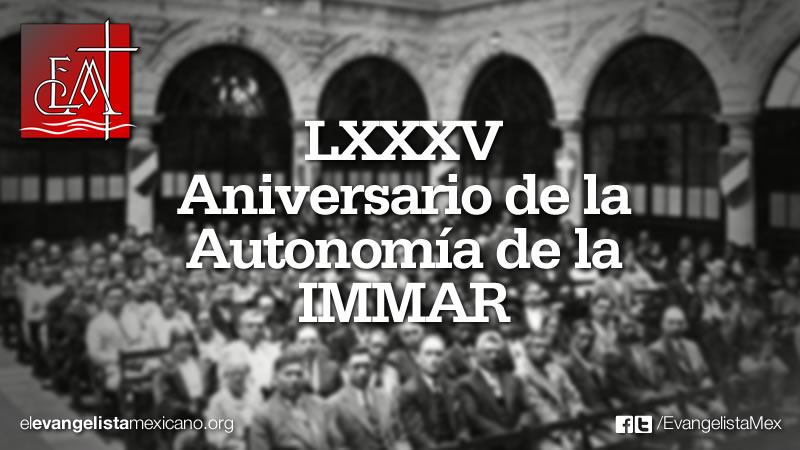
Asamblea Constituyente de la Iglesia Metodista de México, Templo La Santísima Trinidad, Gante No. 5, Ciudad de México; Septiembre de 1930
El artículo que viene enseguida nos fue enviado por el Rev. Edgar Avitia, actual representante de la Junta de Ministerios Globales de la Iglesia Metodista Unida (Estados Unidos) para Latinoamérica y El Caribe. Nos llegó en inglés, y en ese idioma lo publicamos, sabiendo que muchos de nuestros lectores podrán leerlo. Aparece primero el saludo del Rev. Avitia, y enseguida el artículo mismo.

Apreciados hermanos y estimadas hermanas,
Les adjunto un artículo de Yrigoyen, publicado en la revista Methodist History de la Comisión General de Archivo e Historia de La Iglesia Metodista Unida, relacionado al 85avo Aniversario de la Autonomía del Metodismo en México. Puede verse como un recuento y socialización del informe de los trabajos de la Comisión Unida para la Unificación del Metodismo en México, aunque arroja un par de cosas nuevas para alguien como yo; por ejemplo, las fotos que provienen de la aparente basta colección que dicha Comisión General de Archivo conserva, y algunas fuentes de información adicionales de las que no me había yo percatado. Espero que lo disfruten.
Les deseo lo mejor en los trabajos en la próxima reunión de la SEHIM del 17 de octubre. Me hubiera encantado escuchar a nuestros maestros Rodríguez y Ruiz, y echar mano de la Memoria que CUPSA adelantó, pero qué le vamos a hacer.
Con el cariño y respeto de siempre les saludamos.
Rev. Edgar Avitia
ITS 85TH ANNIVERSARY
Charles Yrigoyen, Jr.
On Monday morning, July 7, 1930, at 9:00 a.m., seventeen persons gathered around a table in the chapel of the Union Theological Seminary in Mexico City, Mexico. They were members of the Commission on Unification in Mexico which had been empowered to make final prepara- tions for Methodism in Mexico to become a unified and autonomous church. Those present included duly elected official representatives from the Mexico Conference of the Methodist Episcopal Church (Epigmenio Velasco, J. T. Ramirez, Vicente Mendoza, V. D. Baez, and J. P. Hauser), the Mexico Conference of the Methodist Episcopal Church, South (Juan N. Pascoe, Benjamin Fernández, F. S. Montelongo, Edelmiro J. Espinoza, and Josué de la Fuente), the Methodist Episcopal Church (Ralph E. Diffendorfer, and Juliet H. Knox), and the Methodist Episcopal Church, South (Bishop Warren A. Candler, F. S. Onderdonk, and O. E. Goddard). Methodist Episcopal Church, South, Bishop S. R. Hay and C. A. Bickley were present as substi- tutes for M. A. Childers and Mrs. W. J. Piggott. Bishop George A. Miller and F. S. Wallace of the Methodist Episcopal Church were unable to at- tend.1 Methodist Episcopal Bishop Francis J. McConnell was detained by a railroad wreck until later in the day. By 7:30 p.m., Tuesday, July 8, the Commission completed its deliberations and set into motion plans for the Methodist Church of Mexico. Before describing their actions we pause to remember Methodism’s earlier years in Mexico.
Methodism’s Beginnings and Growth in Mexico
Time permits only a brief historical sketch of Methodism’s beginnings and early development in Mexico. On December 9, 1872, Methodist Episcopal Bishop Matthew Simpson appointed William Butler (1818-1899) to head the denomination’s mission in Mexico. Simpson issued the follow- ing orders to Butler:
You will organize as early and as fully as you can according to the Discipline of the Methodist Episcopal Church. But at the same time you will cultivate the most friend- ly relations, and proceed in the most perfect Christian courtesy with all evangelical societies and ministers, and especially you will cooperate as far as you may with Rev. Dr. [Henry C.] Riley in the work which he has so successfully commenced.
Even before Butler left to take up his duties in Mexico, Methodist Episcopal Bishop Gilbert Haven visited Mexico and organized its first Methodist class in Mexico City on Sunday, January 26, 1873.3 Under the leadership of mis- sionaries and Mexican preachers, “The Mission of the Methodist Episcopal Church” began public worship on March 30, 1873. Seventy Mexicans at- tended the morning service at which Dr. Ignacio Ramirez preached. In the afternoon Butler, having finally arrived, preached in English to a congrega- tion of twenty.4
Methodist ministry in Mexico was enthusiastically supported by the Methodist Episcopal Woman’s Foreign Missionary Society (WFMS) which provided funds and missionaries for the work.5 Throughout its history the WFMS was especially committed to caring for the spiritual and material needs of children and women, not only in Mexico, but wherever it was in- fluential.
From its beginning in Mexico City, the Methodist Episcopal mission reached out to establish centers in other places such as Pachuca, Puebla, Orizaba, Cordoba, Miraflores, Amecameca, Guanajuato, Queretaro, and Celaya.6
Recognizing the success of its ministry in Mexico and realizing the great potential of the Mexican work, the 1884 Methodist Episcopal General Conference authorized the organization of a Mexico Annual Conference which was convened on January 15, 1885, at Holy Trinity Church, Gante 5, Mexico City, by Methodist Episcopal Bishop W. L. Harris.7
Regrettably, through much of their earlier history, Mexican Methodists were molested verbally and physically, especially in places where they es- tablished new congregations. Some of the persecution they suffered was spawned by hostile Roman Catholic leaders and people.8 Nevertheless, al- though slowly, Methodism grew. It survived the Revolutionary period which began in November, 1910, although in some parts of the country, such as Guanajuato and Oaxaca, Methodists were the target of continuing discrim- ination and violence.9
The Mexican Constitution of 1917 created a new set of challenges for Methodists and other religious groups. Among its provisions, teaching reli- gion in public and private schools was forbidden. The ministry was reserved solely for native-born Mexicans whose activities were limited to conducting worship and administering the sacraments. It was clear that religion and politics were to be separated, although the Constitution generously provided for “freedom of religious affiliation and religious practice for individuals.”10 The Revolution and the Constitution produced major change for the status of foreign missionaries and possibilities for their ministry.
The Methodist Episcopal Church, South (MECS), which divided from the Methodist Episcopal Church in 1844 over the slavery issue in the United States, began work in Mexico in 1872 when Alejo Hernandez (1842-1875) was appointed by Bishop E. M. Marvin. Hernandez had been converted to Protestantism, was licensed to preach, and in 1871 was ordained dea- con by the West Texas Annual Conference “for missionary work among the Mexicans.”11 Hernandez was the pioneer of Spanish-speaking work for southern Methodism in Texas and Mexico.12 In 1873, he was transferred to Mexico City by Bishop John C. Keener and died two years later.
The Methodist Episcopal Church, South, organized congregations in northern Mexico as well as Mexico City. The southern church’s ministry was strengthened by William M. Patterson who was appointed to superintend it in 1878.13 Three of the early outstanding Mexican leaders of its work were Sóstenes Juárez, Cueas Mota, and Francisco de Villegas.14
Authorized by the 1878 southern Methodist General Conference, the Mexican Border Mission Conference, which later divided into two Conferences, was organized on October 29, 1885. The following year another Annual Conference was created and named the Central Mexican Conference. In these Conferences the church carried on evangelistic, edu- cational, and social work ministries. As was the case with the missions of the northern church, women provided substantial support for the work of the southern church in Mexico. The Woman’s Missionary Society of the Methodist Episcopal Church, South, was specifically involved in establish- ing and maintaining schools.15
Some will find it ironic that the Methodist Episcopal Church, South (southern Methodism), established its work principally in northern Mexico, while the Methodist Episcopal Church (northern Methodism) founded its ministry principally in southern Mexico.
The Path to Union and Autonomy
A number of factors were involved in the decision for Methodist autono- my in Mexico. At least three are as follows.
First, the enforcement of the 1917 Mexican Constitution made it increas- ingly difficult for foreign missionaries to continue their ministries in Mexico since worship, preaching, and evangelizing were reserved for Mexican-born ministers and laypeople. It seemed clear that foreign missionaries were not welcome, although some remained in Mexico after autonomy to do educa- tional work.
Second, from the start the two Methodist denominations which per- formed their work in Mexico realized that Mexican men and women had to be recruited, trained, and enlisted in the leadership of Mexican Methodism. Methodism could not survive without the talents, commitment, and leading of Mexican men, women, and young people, i.e., “indigenous leadership.” It was apparent that Mexican Methodism would serve God better if it were an independent church. The Mexican people had known this from the earliest days.
Third, the twentieth-century spirit of ecumenism contributed to the wis- dom and necessity of a united and autonomous Mexican Methodist church. As early as 1888, various Protestant denominations including Presbyterians, Baptists, Congregationalists, Episcopalians, Friends, and Methodists held a general assembly of their missionaries in Mexico City where they discussed important facets of their work and the pressing need for cooperation. Other ecumenical meetings were held in 1897 and 1919 in which agreement was reached for increasing cooperation among the churches in their mission work in Mexico.16 The National Council of Evangelical Churches in Mexico was formed in 1927 to coordinate Protestant efforts. Furthermore, in the early years of the twentieth century, the two Episcopal Methodisms became more interested in their possible reunion. In 1898, both churches formed commissions on federation and ultimately constituted a Joint Commission on Unification to bring the two denominations together. The two Episcopal Methodisms united with the Methodist Protestant Church on April 26, 1939, in Kansas City, Missouri, to form The Methodist Church. The movement toward the unification of episcopal Methodism facilitated the autonomy of Mexican Methodism.
An important action was taken by the Methodist Episcopal Church, South, General Conference May 19, 1926, when it adopted a resolution from its Committee on Missions which in part read as follows:
Be it resolved: 1. That the Board [of Missions] looks with favor upon any movement among our Mexican Methodists which has for its purpose the development of a nationalist spirit of self-reliance, and the Board desires to assist in the cultivation of self-direction and self-support on the part of our Mexican Church.17
A Committee on Mexico was appointed which expressed “the hope that lead- ership in the work of the Church [in Mexico] shall pass into Mexican hands as rapidly as may be possible . . . .”18
A delegation of Methodists from Mexico attending the 1928 Methodist Episcopal General Conference petitioned the delegates seeking authorization for its Mexico Conference to unite with the southern Methodist Episcopal work in order to form an autonomous Methodist Church of Mexico.19 As a result, the General Conference adopted the following report on May 25, 1928:
- To authorize the Mexico Annual Conference of the Methodist Episcopal Church to be united with the Mexico Annual Conference of the Methodist Episcopal Church, South, and to be organized into the Methodist Church of Mexico, provided such authorization is also given by the General Conference of [t]he Methodist Episcopal Church, South, to its Mexico Annual Conference.
- To request the Bishops to appoint a commission to meet with a like commis- sion of the General Conference of the Methodist Episcopal Church, South, and with a similar commission from the two Annual Conferences in Mexico, which Joint Commission shall be authorized to formulate a basis of union, to call an autonomous Conference in Mexico and to perform such other acts as may be necessary in the or- ganization of the Methodist Church of Mexico. It is recommended that all possible preliminary steps be taken in this direction prior to the next session of the General Conference of the Methodist Episcopal Church, South.
- To instruct the Joint Commission, in preparing the basis of union and planning the organization of the Methodist Church of Mexico, to provide for continued organic relationship of the present Conference with the Methodist Episcopal Church and the Methodist Episcopal Church, South, respectively.
Frank Mason North, a prominent leader in the denomination, offered an amendment which gave authority to the Methodist Episcopal representatives to the Joint Commission to act on the denomination’s behalf in negotiations with commissioners of the southern church. The northern church’s dele- gates were named (Bishops Miller and McConnell, R. E. Diffendorfer, F. S. Wallace, and Juliet Knox).
Meeting in Saltillo in 1928, the Mexico Conference of the Methodist Episcopal Church, South, appointed five commissioners to the newly formed Joint Commission (B. Fernández, J. de la Fuente, F. S. Montelongo, E. J. Espinoza, and J. N. Pascoe).
Meeting in Mexico City, March 6-10, 1929, the Mexico Conference of the Methodist Episcopal Church heard a report on the status of its relations with the southern church’s Annual Conference and approved a motion endorsing such actions as were necessary to unite with the Annual Conference of the southern church. At its sessions in Puebla, February 20-24, 1930, it voted to continue the membership of its representatives to the Joint Commission (E. Velasco, Vicente Medoza, J. P. Hauser, J. T. Ramirez, and V. D. Báez).
In summary, both denominations and their Annual Conferences in Mexico agreed to enter into serious negotiations for unification and auton- omy. Furthermore, the four respective bodies chose delegates to represent their interests in the formation of a unified and autonomous church.
The Joint Commission on Unification
The work of the Joint Commission on Unification in Mexico was pivotal to the birth of the new church. The Commission laid the foundations for birth- ing the church whose 75th anniversary we celebrated in 1930. Fortunately, we have a published record of the Joint Commission’s meetings and decisions in a booklet which was released shortly after their work was completed. We proceed now to retell the story of the Joint Commission’s four sessions held July 7-8, 1930, in the chapel of Union Theological Seminary, Mexico City.
The First Session
Ralph E. Diffendorfer, Corresponding Secretary of the Board of Foreign Missions of the Methodist Episcopal Church, called the meeting to order at 9:00 a.m. Southern Bishop Warren A. Candler was elected Chairman of the Commission and northern Bishop Francis J. McConnell was elected Vice- Chairman. Juan N. Pascoe was chosen Spanish Secretary and Diffendorfer was named English Secretary. Vicente Mendoza and J. P. Hauser were se- lected to translate.24
Representatives of each of the four principal bodies presented and depos- ited official copies of the minutes and resolutions related to the Commission’s work as well as the names of those appointed commissioners. Bishop Candler reminded the Commission of the importance of its objectives. Following a period of prayer led by Mendoza, Velasco, and Onderdonk, the agenda was adopted and the roll was called.25
Bishop Candler asked for the reading of the General Conference reso- lutions which authorized unification and autonomy. The resolutions of the Methodist Episcopal Church were presented first and reflected the position of its Mexican delegates to the 1928 General Conference. They read in part:
It has long been the desire of the people of the two Methodisms in Mexico to enter upon closer organic relations, as was evidenced by the[ir] strong vote in favor of unification. The existence of a division into two separate camps of our common Methodism is a distinct disadvantage to the entire work. The constitution of Mexico and conditions there made a change advisable, not to say imperative.
The Methodist Episcopal resolutions called for the uniting of the Mexico Annual Conferences of both churches and requested “continued organic re- lationship” of the new Mexican church with both the northern and southern churches.26
As early as its 1926 General Conference of the Methodist Episcopal Church, South, adopted the following policy.
[T]he General Conference expresses its appreciation for the vigorous growth of our work in Mexico, and looks with favor upon any movement among our Mexican Methodists that has for its purpose the development of a spirit of efficiency and self-reliance. The General Conference desires to assist in every way in developing the principle of self-direction and self-support in the Mexican Conference and to that end expresses the hope that leadership in the work of the Church shall pass into Mexican hands as rapidly as may be possible; for while in the propagation of the gospel there is no distinction of country or race, we hold as a cardinal principle of expediency and efficiency in missionary administration that foreign control, alike with foreign support, shall continually decrease, to make room for native growth, and giving place to the moral play of native responsibility and initiative.27
The resolutions of the Methodist Episcopal Church, South, read to the Joint Commission echoed the policy adopted by the southern church in 1926.
They authorized their Mexico Annual Conference to join with the north- ern church’s Annual Conference, the two to be organized as the Methodist Church of Mexico, an autonomous church which would meet the needs of the Mexican people through the preaching and ministry of the Gospel of Christ.28 The resolutions of both churches made clear their intention to sup- port unification of their Annual Conferences in Mexico and the creation of an autonomous church.
The Commission then took up the matter of the name of the new church. F. S. Montelongo moved that the name be simply, “The Methodist Church.” After much discussion, it was moved that the name be, La Iglesia Metodista de Mexico, The Methodist Church of Mexico. This name was approved.29
Next, the Commission considered the relationship of the new church to its “mother churches.” It was agreed that the Methodist Church of Mexico would have its own legislative General Conference and exchange “fraternal delegates” with the General Conferences of both northern and southern epis- copal Methodisms. The matter of “continued organic relationship” raised in the Methodist Episcopal resolution read to the Commission earlier was re- ferred to a sub-committee (predominantly American) and a second sub-com- mittee (predominantly Mexican) was named to create and recommend a Constitution for the new church. The Sub-Committee on Constitution was instructed to provide for a General Conference, two Annual Conferences, and the election of bishops.30
The Second Session
Beginning at 3:00 p.m. with worship, the Joint Commission convened with Bishop Candler appointing the two Sub-Committees. It was decid- ed that the two Mexico Annual Conferences of the northern and southern churches no longer existed, having been superseded by Annual Conferences to be organized by the Methodist Church of Mexico.
Since the Commission had agreed that the new church would be governed by a General Conference, it considered the question of how the General Conference of the new church would be composed. After considerable dis- cussion the Commission adopted the following motion.
The first General Conference of the Methodist Church of Mexico shall consist of the effective full members of the Mexico Conference of the Methodist Episcopal Church, and the Mexico Conference of the Methodist Episcopal Church, South, together with one lay delegate from each Quarterly Conference now being served by a member of an Annual Conference and four laymen at large from the Mexico Conference of the Methodist Episcopal Church and four laymen at large from the Mexico Conference of the Methodist Episcopal Church, South, these laymen at large to be appointed by the District Superintendents of the two Conferences respectively, thereby providing an equal number of lay and ministerial delegates.31
It was agreed that the two Sub-Committees would meet after the evening meal to consider the matters assigned to them.
The Third Session
On July 8 at 9:00 a.m., Bishop Candler convened the Joint Commission’s third session. After worship, which included prayer, the singing of “O Cristo Mio,” and brief routine matters, the Sub-Committee on the Relation of the Methodist Church of Mexico to its “mother churches” was presented. An exchange of fraternal delegates was approved. The question of the formal relationship of the new church to its “mother churches” was resolved by the Commission’s agreement to create a Council of Cooperation which would manage these relationships. The Council would be composed of eight representatives (“including ministers, laymen and lay women”) elect- ed by the Methodist Church of Mexico, four representatives (including two women) appointed by the Board of Missions of the Methodist Episcopal Church, South, two appointed by the Methodist Episcopal Woman’s Foreign Missionary Society, and two by the Methodist Episcopal Board of Foreign Missions. The Council was to deal with financial cooperation, as well as property and foreign missionary concerns.32
Reporting for the Sub-Committee on Constitution, southern Bishop Samuel R. Hay said that the Sub-Committee was not prepared to write a complete and faultless Constitution for the new church. The Sub-Committee was submitting only a skeletal document modeled on the Constitution of the Methodist Episcopal Church. It was assumed that the General Conference of the Methodist Church of Mexico would ultimately perfect and complete its own constitutional document.33
The report of the Sub-Committee was read and discussed. A few changes were made in the document relating to the powers of the General Conference. The report was approved with amendments.34
The Commission then considered the place and date of the first General Conference of the new church. Benjamin Fernández invited the General Conference to Saltillo and Vicente Mendoza issued an invitation for Mexico City. After careful consideration the Commission voted that the General Conference would be held in Mexico City and would commence on Tuesday, September 16, 1930 at 10:00 a.m., with the consecration of the first bishop on Sunday, September 21.35
The issue of episcopacy was raised by V. D. Báez. He asked whether the new church would use the title, “General Superintendent” or “Bishop” for its chief executive. The Commission voted to employ the title “Bishop” and instructed the Sub-Committee on Constitution to use this term in the new constitutional document.36
The Fourth Session
The final meeting to the Joint Commission began at 5:30 p.m. on July 8 with prayer and the singing of “Más Cerca, Oh! Dios, de Ti.” The Commission listened to and approved “The Proclamation Regarding Unification and the Organization of The Methodist Church of Mexico.” This document declared the union of the two Mexican Annual Conferences and the newly constituted church, The Methodist Church of Mexico.37 The Constitution of the new church was accepted without reading and one change was made in Division I, Paragraph 23 regarding the Articles of Religion.38 It was decided that the historic General Rules, originally formulated by John Wesley, were to be in- cluded in Division II of the Constitution with a notation to indicate their pres- ent relevance.39 Division III of the Constitution, “Articles of Organization and Government,” was accepted with two changes to the Article dealing with the Council of Cooperation. The Commission then unanimously ad- opted the documents by a rising vote.40 After a few closing matters, the Joint Commission adjourned with a benediction by Bishop McConnell. With the work of the Commission completed, the preparation for the final two steps was in place—the convening of the General Conference and the election of an episcopal leader.
The First General Conference and Episcopal Election
Speaking for the Joint Commission on Unification, Bishop Warren A. Candler issued the call for the First General Conference of the Methodist Church of Mexico to be held at the Church of the Holy Trinity, Mexico City, beginning September 16, 1930, which was also Mexico’s Independence Day. In addition to a description of those eligible to be voting delegates, as deter- mined by the Joint Commission’s decision,41 Bishop Candler also declared:
The General Conference is authorized to perfect its own organization and to proceed to such business as may be necessary. The Conference is authorized to elect one Bishop from among the effective elders and to consecrate him on Sunday, September 21, 1930.42
J.P. Hauser recorded a summary of the actions of the Conference from which the following information has been drawn.43
As planned, the General Conference convened on Tuesday, September 16, 1930 at 10:00 a.m. with a Service of the Lord’s Supper led by the Presiding Elders of the former Frontier Annual Conference and the District Superintendents of the former Central Annual Conference Church. Ninety delegates were in attendance, “an equal number of ministers and laymen.”44 The Conference proceeded to elect a President (V. D. Báez), Vice President (Benjamin Fernandez), Secretary (J. T. Ramirez), Assistant Secretaries (E. J. Espinosa and Carlos Laguna), and Treasurer (J. de la Fuente). P. Flores Valderrama addressed the Conference on the topic, “Objectives and Outlook of Methodism” and Juan N. Pascoe, Spanish-language Secretary of the Commission on Unification, offered a presentation on the documents which authorized the organization of the new church. After the reading of Committee assignments, the Conference adjourned to permit its committees to consider the business given them. Since it was Mexico’s Independence Day, no further program was scheduled.
The following day, September 17, the Committee on Episcopacy made its report which, according to Hauser, had five main points:
(1) The Episcopacy of the Methodist Church of Mexico is not a life office, nor does it constitute a Hierarchy, but is an Administrative office.
(2) The Bishop shall be constituted by the election of the General Conference (two- thirds vote on secret ballot) and by the imposition of the hands of four elders and a Bishop; but in case no Bishop is present, then five elders shall perform this cere- mony.
(3) If from death or any other cause there is no Bishop, the Annual Conferences and the District Elders are empowered to carry on the work until the next General Conference, but without the power to ordain.
(4) The Annual Conferences and the District Elders are empowered when the office of Bishop shall be vacant, to call at their own judgment, a General Conference for the election of a new Bishop who shall be consecrated by five elders and shall con- tinue in office until the following General Conference.
(5) The Bishop, in his conduct, is responsible to the General Conference.45
On morning of Friday, September 19, at its fifth session President Báez announced that the time for the election of the first bishop of the church had arrived. Before the balloting began, however, several matters related to the bishop’s salary and residence had to be determined. The Conference approved 6,360 pesos for the salary, rent, and a stenographer for the new bishop. This amount was to be raised by the congregations of the two Annual Conferences. It was decided that the residence of the bishop should be Mexico City unless the churches found this location inconvenient, in which case the residence could be located in another community within the Episcopal area. President Báez also announced that the election would be by secret ballot without previous nomination and would be completed on the person’s receiving two-thirds of the votes of the members present and voting.46
From the first ballot it was obvious that only two candidates received significant votes—V. D. Báez and Juan N. Pascoe. After seventeen ballots neither of these men received the required two-thirds. Pastor E. Velasco “proposed that the [Constitutional] article already approved requiring a two- thirds vote for the election of a bishop be continued as the basis for future elections, but that for this time only the election be decided by a majority vote.”47 The delegates agreed and Juan N. Pascoe was elected on the eigh- teenth ballot.
Bishop Juan Nicanor Pascoe (1887-1962) received his earliest education in Mexico, and then attended Vanderbilt University, Nashville, Tennessee, where he met his future wife, Elisa Steel, an active Methodist who held prom- inent offices in Mexican women’s missionary societies. After their return to Mexico, Pascoe was appointed to several churches related to the Methodist Episcopal Church, South, in Mexico City, Chihuahua, Saltillo, Allende, San Antonio (Texas), and Monterey. He served a term as Superintendent of the Monterey District. A leader in the church’s youth work, Pascoe was also identified with the unification movement in Mexico. His election was enthu- siastically celebrated in Mexico, the United States, and elsewhere.48
On the day following the election of their new bishop, Saturday, September 20, the sixth session of the General Conference convened. The body approved the appointment of a committee to publish a new Discipline while agreeing that in all matters where no legislation had been formulated by the General Conference, the Disciplines of the two former churches shall apply. The Conference also voted to endorse Union Theological Seminary as its own training institution and pledged to support it in every way possible.49
The consecration of Bishop Juan Nicanor Pascoe took place on Sunday, September 21, at the Church of the Holy Trinity, Gante 5, Mexico City. According to reports, the church was filled to capacity. Methodists from the city and its environs crowded in to celebrate their first Bishop. An appro- priate liturgy had been planned with a sermon by Benjamin Fernandez. V. D. Báez presided at the formal consecration assisted by Vicente Mendoza, Benjamin Fernandez, I. D. Chagoyán, J. de la Fuente. Since it had been erroneously reported in one of the city newspapers that Bishop Pascoe was not a Mexican citizen, Dr. Báez asked the Conference Secretary to read a document from the Department of the Interior stating the Bishop Pascoe was indeed a citizen of Mexico.50
The final three sessions of the General Conference occurred on Monday, September 22. Bishop Pascoe presided. The General Conference ap- proved the name of their youth organization, “The Methodist Young Peoples League.” Bishop Pascoe appointed a number of important committees. Elections of officials and ecumenical representatives were held. The General Conference endorsed the names of its two Annual Conferences—the Central
Annual Conference and the Frontier Annual Conference. The new church’s periodical, El Evangelista Mexicano, was approved and Vicente Mendoza was named Editor. The first days of September, 1934, were decided upon as time of the next General Conference. Saltillo was decided as the loca- tion. The First General Conference of The Methodist Church of Mexico ad- journed with prayer by E. Velasco.51 With the completion of the first General Conference the new church had been officially organized and was ready for a new era in the ministry of Methodism in Mexico. Reflecting on what had taken place in Mexico, the Corresponding Secretaries of the Methodist Episcopal Church reported:
With the union of the two Methodisms, the Methodist Church of Mexico is now the largest evangelical body in Mexico and is characterized by an able Mexican leadership, an emphasis on personal loyalty to Jesus Christ as Saviour and Lord, an evidence of salvation in personal living and a deep interest in all social problems.52
Expectations and Early Assessment
Writing for the Methodist Episcopal Board of Foreign Missions Corresponding Secretaries Report of 1931, Bishop Pascoe briefly described the work of the Joint Commission on Unification and the actions of the first General Conference. He also reported that a Discipline for the new church had been published. His report included special mention of the Disciplinary provisions for the episcopacy which read as follows:
Art[icle] I. The Episcopacy in the Methodist Church of Mexico is not for life and does not constitute a hierarchy. It is simply an administrative office. Art[icle] II. The bishop shall be constituted by the election of the members of the General Conference and through the imposition of hands of a Bishop and four elders, remaining in his work for four years, without re-election.
Art[icle] VI. Requirements for a bishop are as follows: 1. He must be a Mexican by birth and citizenship. 2. He must be forty years old at least. 3. He should have been an effective elder for ten consecutive years before his election. 4. His record of service ought to be, both in his personal life and in his ministry, an “unsullied one.”53
Bishop Pascoe proceeded to answer two important questions. First, he dealt with the question raised by some about the readiness of Mexican Methodism to become autonomous. If judged by statistical evidence alone, he stated, perhaps Mexico as not ready. With a membership of 10,000, about 100 preachers, and only sixteen self-supporting charges, it would appear that the church was not fully prepared for autonomy. However, he asked:
Is autonomy simply a question of numbers and of money? Does it depend on ma- terial things or on spiritual values? Have not ten thousand Mexican Methodists and a hundred Mexican preachers a right to legislate for themselves, to think for them- selves, to form their own plans, to meet their own problems, and even, as someone has stated, “to make their own mistakes”?
Furthermore, the laws of Mexico made it both expedient and necessary for the church to become independent and to have a Mexican bishop. It was quite clear that Mexican Methodism was ready for autonomy. He argued:
Taking into account . . . spiritual values and . . . existing conditions in Mexico, there is only one conclusion to be arrived at: The establishment of the Methodist Church in Mexico was a very wise and opportune step. It proves beyond any doubt the desire of American Protestantism to secure in Mexico and in other foreign countries but one thing, the spread of the Gospel of our Lord Jesus Christ, and the establishment of His Kingdom.54
The Bishop dealt then with a second question, “What does the new church signify?” He responded with three concise statements:
- It means the realization of two great ideals: unification and autonomy.
- It works for efficiency, bringing out initiative, developing a sense of responsi- bility.
- It has come in a time of crisis, but it will prove the best means to meet this crisis. We are doing the same work that was being done ten years ago, with one third of the money then spent.
Bishop Pascoe also mentioned that one of his preachers was apparently dis- pleased that the “mother churches” had reduced their financial assistance to the new church. Others thought differently. The Bishop quoted another pastor who exclaimed:
It is much better that this should happen rather than that appropriations should have been increased. This withdrawal of funds brings out the best that is in us, it forces us to our knees [in prayer], it provides us with one more argument with which to appeal to our people, and teaches us to depend more on them. This financial depression is a blessing. Let us do our best, and remember that God is with us still.55
Continuing his statement on the status of Mexican Methodism, Bishop Pascoe cited the building of new roads which made travel for the preach- ers both easier and safer, the disappearance of the huge haciendas whose powerful proprietors who often resented Methodist preachers, the opening of many rural schools which “pave the way for the Gospel,” and the Roman Catholic campaign against Protestantism which Methodists were countering with tracts and Gospel preaching. He also celebrated the educational work of the new church and the accomplishments of Union Theological Seminary. In closing, the Bishop announced:
Thus the future of the new Church is bright and hopeful. Our relations to the mother Churches have changed, but the responsibility for us and for them has increased, because the possibilities and the opportunities have also increased. We cannot show the results of this wise policy in such a short time, but feel sure that every year of the ensuing four years will demonstrate the wisdom and effectiveness of the step taken.56
Among the challenges faced by the new church was reaching out to a new generation of Mexican men and women. In a 1931 report of the Methodist Episcopal Board of Foreign Missions the following was stated:
Outstanding among [the new opportunities in Mexico] is a new approach to young educated Mexicans—the products of government schools, the rural and state normal schools for teachers and the National University. This group is increasing in number by the thousands each year. Many of them have long since lost interest in the Roman Church in Mexico, and in view of the events of recent years, we are likely to see a generation of young Mexicans, educated, influential and modern in every respect, but without any religious education whatever. Some indeed, will be antagonistic to all religion, for the influences from Russia and elsewhere to this effect have already penetrated Mexico and are common talk in educated circles. This need can be met at the present time only by a sympathetic and kindly approach outside the ordinary evangelical church circles. A new type of missionary, non-ministerial, but deeply religious, socially-minded, and with sympathy and understanding of Mexico’s cul- tural heritage, could render this group an enormous service in the coming days.57
Conclusion
Someone has said that people with amnesia don’t know who they are because they cannot remember the past. Our history is an indispensable component in our identity. This 85th anniversary of the Methodist Church of Mexico offers a unique opportunity to remember from whence we have come and who we are. We recall those men and women who more than a century ago, who before Methodist unification and autonomy, gave themselves to God in Christ, embraced the Wesleyan message, and committed themselves to holiness of heart and life. There would be no Methodism in Mexico with- out them. We honor the memory of the men and women who made the decision for Mexican Methodism to become a full and autonomous church and who embarked on a heroic and sacrificial journey which has brought us to this moment. Some of them may be our grandparents or parents. Most of them have moved on to the greater Kingdom of God, but we remember them, faithful laypeople, pastors, Superintendents, and Bishops. There would be no Methodist Church of Mexico without them. Through their faith and life, and in the desperate circumstances of our own time, the triune God calls us to new life and faithfulness.
As we acknowledge our debt to the past and its place in shaping our iden- tity, we know, as the modern hymn says, “This is a day of new beginnings, time to remember and move on.”58 May God bless you and may He bless the ministry of the Methodist Church of Mexico.
Notes on Sources
The United Methodist Church has a central archives and library on the campus of Drew University in Madison, New Jersey, USA. The Center houses two climate-controlled archives vaults with a capacity of 180,000 cu- bic feet. Its library holds approximately 80,000 volumes and 2,000 periodi- cal titles, and receives approximately 600 periodical titles on a regular basis.
Among its holdings is a considerable amount of information on the his- tory of Methodism in Mexico. There are many secondary resources as well a significant amount of primary source information. We have the journals of all the General Conferences of the Methodist Episcopal and Methodist Episcopal Church, South, churches, the annual reports of their mission agencies, missionary reports and correspondence, minutes of the Council of Cooperation, and other documents. In the serials and periodical collection there are some issues of El Evangelista Mexicano and a sizeable collection of Annual Conference Minutes from the nineteenth century to the middle of the twentieth century.
Among the more notable Mexican items in the collection are ten albums of photographs (approximately 7,000 images) which offer important views of the people and sites of Mexico and Mexican Methodism in the first half of the twentieth century.
 El Evangelista Mexicano